

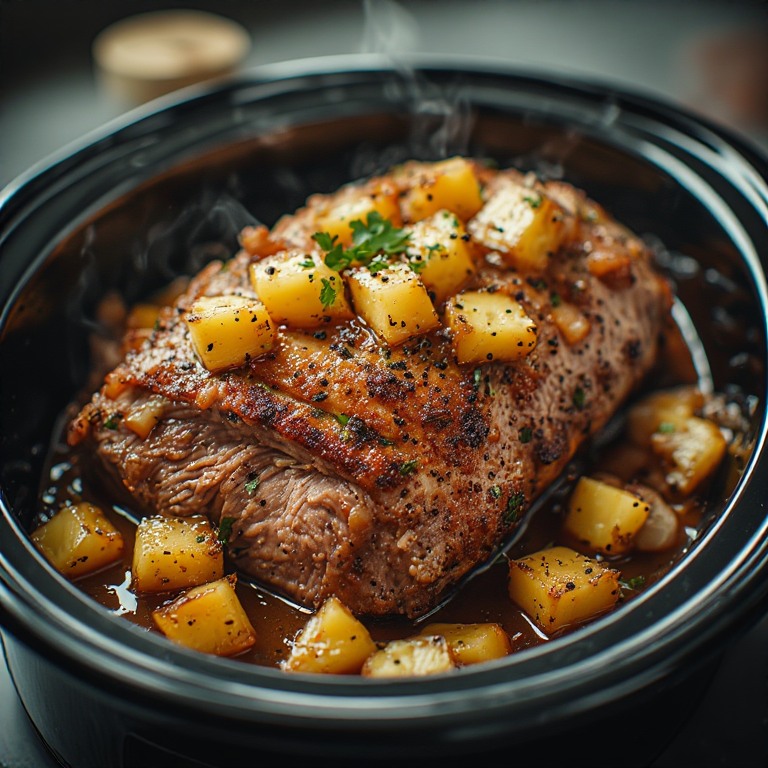
Slow Cooker Amish Apple Pork Loin
There’s a particular kind of recipe that doesn’t announce itself loudly — no long ingredient list, no elaborate technique, no special equipment required — and yet produces something so satisfying that it quietly becomes the meal people request on repeat. This Slow Cooker Amish Apple Pork Loin is exactly that recipe. A boneless pork loin goes into the slow cooker on a bed of sliced onions, gets covered with unsweetened applesauce, and cooks low and slow for hours while you go about your day. What comes out is a deeply tender, gently sweet, savory roast with a built-in sauce that tastes like it took considerably more thought than it did.
The combination of pork and apples is one of the oldest and most reliably good flavor pairings in Western cooking. Apples provide natural sweetness and a mild acidity that cuts through the richness of pork in a way that nothing else quite replicates. In the Pennsylvania Dutch and broader Midwestern farmhouse traditions that inspired this recipe, cooks relied on preserved apples and inexpensive pork cuts to produce nourishing, crowd-feeding meals from pantry staples. This version honors that spirit completely: five ingredients, one pot, minimal effort, and a result that earns the table’s full attention.
Why This Recipe Works
The slow cooker is particularly well-matched to pork loin precisely because pork loin is a lean cut with little fat or connective tissue to protect it from drying out. On high oven heat, pork loin can become dry and fibrous quickly if you miss the window of perfect doneness by even a few minutes. The slow cooker’s moist, low heat environment keeps the exterior and interior at nearly the same temperature throughout the cook, and the applesauce provides additional moisture that bastes the meat continuously from above. The result is a roast that’s tender through and through rather than juicy only at the center.
The applesauce does more than just keep things moist. As it cooks, it concentrates and deepens, its natural sugars caramelizing slightly at the edges of the insert and the fruit flavor becoming rounder and more complex over the hours. The sliced onions below the pork soften completely, sweeten, and meld with the applesauce into a rustic, textured sauce that’s somewhere between a compote and a pan sauce — spooned generously over each slice of pork, it’s one of the most straightforward and satisfying sauces in the slow cooker repertoire.
A Note on Tradition
Pork cooked with apples or apple products has roots throughout European and American culinary history. In Pennsylvania Dutch (Amish and Mennonite) cooking, the combination appears in various forms — roast pork with applesauce, pork chops braised with dried apples, ham glazed with apple cider. The tradition reflects the agricultural reality of farming communities where apple orchards and pig farming often went hand in hand, and where cooks made use of what was abundant and preserved well through winter. Applesauce specifically — shelf-stable, easy to put up from a harvest, and naturally sweet — was a practical braising ingredient long before it became a condiment. This recipe carries that practical wisdom forward in a form that fits the contemporary kitchen perfectly.
Why You’ll Love This Recipe
The appeal begins with the effort required, which is genuinely minimal. The active preparation time is under ten minutes: slice the onion, season the pork, pour in the applesauce, and set the slow cooker going. After that, there’s nothing to do until the pork is done. No basting, no checking, no adjustments. For a Sunday dinner that feeds six people, that kind of hands-off cooking time is almost unreasonably generous — the afternoon stays free while the kitchen fills with an increasingly wonderful smell.
The flavor pays off the simplicity in full. The combination of savory pork, sweet applesauce, and softened onion cooked together over hours produces a dish that tastes nuanced and intentional without requiring any of the additional steps that usually create that kind of depth. It’s a meal that satisfies a real hunger — the kind that calls for a proper sit-down with people you like, crusty bread on the table, and seconds.
Ingredient Notes
Boneless pork loin roast, 3 to 3.5 pounds, is the right cut for this method. Pork loin is lean, tender when cooked properly, and slices cleanly into attractive portions. A boneless roast is easier to position in the slow cooker and to carve cleanly after resting. Note that pork loin and pork tenderloin are different cuts — tenderloin is much smaller and more expensive, and would be significantly overcooked by a 6 to 8 hour low setting. Make sure you’re buying the loin roast, not the tenderloin. Trim any excess fat cap from the surface if it’s thicker than about a quarter inch, which helps the applesauce contact the meat more directly.
Unsweetened applesauce is the right choice here. Sweetened applesauce can push the finished dish past the sweet-savory balance into something that reads more like a dessert than a dinner, particularly if you add any brown sugar to the recipe as well. Unsweetened applesauce lets the natural apple flavor come through and allows you to add sweetness deliberately if you want it. Two cups is the right amount for a roast of this size — enough to create a generous sauce and keep the pork moist throughout the cook without turning the insert into a soup pot.
Yellow onion, thinly sliced into rings or half-moons, forms the bed that the pork rests on. This serves two functions: it keeps the pork loin elevated slightly off the direct heat of the insert bottom (preventing any scorching of the lean meat), and it cooks down into a deeply sweet, savory component of the final sauce. A medium yellow onion is the standard choice. A large sweet onion, like a Vidalia, produces a milder, more caramel-forward result. White onion works but is slightly more pungent and less sweet than yellow.
Kosher salt and freshly ground black pepper are the only seasonings in the base recipe, which is deceptively sufficient. The salt seasons the meat directly and draws some of its juices out to combine with the applesauce, and the pepper adds a mild background warmth. The simplicity of the seasoning is intentional — the apple and onion provide all the complexity the dish needs, and over-seasoning can compete with rather than support those flavors. That said, there is plenty of room to expand the seasoning profile if you’d like more savory depth (see Variations below).
Ingredients
- 3 to 3½ lbs boneless pork loin roast, trimmed
- 2 cups unsweetened applesauce
- 1 medium yellow onion, thinly sliced
- 1 tsp kosher salt
- ½ tsp freshly ground black pepper
Step-by-Step Instructions
Step 1 — Layer the Onions
Spread the thinly sliced onion in an even layer across the bottom of a 5- to 7-quart slow cooker. Take a moment to spread them out so they form a reasonably even bed rather than a pile — the pork will rest on top of them, and an even layer provides more consistent support and more even contact with the heat from below.
Step 2 — Season the Pork
Pat the pork loin dry on all surfaces with paper towels. This step is worth doing even though the pork is going directly into a moist cooking environment — drying the surface helps the salt adhere evenly rather than sliding off wet meat, and it ensures better seasoning penetration. Sprinkle the kosher salt and black pepper all over the surface of the pork, pressing gently with your hands so the seasoning adheres rather than falling off when you transfer the roast to the slow cooker.
Step 3 — Add the Pork and Applesauce
Place the seasoned pork loin directly on top of the onion bed, fat side up if there is a visible fat cap. Positioning the fat side upward allows whatever fat is present to baste the meat as it renders during cooking. Pour the unsweetened applesauce evenly over the top of the pork, letting it run down the sides of the roast into the onion layer below. Don’t worry about the quantity — two cups looks like a lot at this stage, but much of it will be absorbed by the meat and onions over the cooking time, and the remainder concentrates into the sauce.
Step 4 — Cook Low and Slow
Cover the slow cooker and cook on LOW for 6 to 8 hours, or on HIGH for 3.5 to 4 hours. The pork is done when it’s very tender and an instant-read thermometer inserted into the thickest part of the roast reads at least 145°F (63°C), which is the USDA safe minimum for whole cuts of pork. At this temperature the pork will be slightly rosy in the center, which is fully safe and produces the most tender, juicy result. Cooking beyond about 160°F produces a drier, more well-done result that some people prefer — the slow cooker’s moist environment makes this more forgiving than the oven, but there’s still a notable texture difference between a 145°F and a 165°F pork loin. LOW for the full 6 to 8 hours is the preferred method for maximum tenderness and depth of flavor in the sauce.
Step 5 — Rest the Pork
Carefully lift the pork loin from the slow cooker with tongs or a large slotted spatula and transfer it to a cutting board. Allow it to rest for 10 minutes before slicing. This rest is not optional — the muscle fibers of a roast that has been cooking for hours are saturated with liquid, and cutting immediately releases much of that moisture onto the cutting board rather than keeping it in the meat. Ten minutes of resting redistributes the juices and produces noticeably moister slices.
Step 6 — Finish the Sauce
While the pork rests, stir the onions and applesauce together in the slow cooker insert. The onions will have softened completely and the applesauce will have deepened in color and flavor. Stir until they form a cohesive, rustic sauce. Taste and adjust the seasoning — a pinch more salt, a grind of pepper, or a small splash of apple cider vinegar for brightness if the sauce tastes flat. If you prefer a thicker sauce, transfer the contents of the insert to a small saucepan and simmer over medium heat for 5 to 8 minutes until reduced to your preferred consistency, or stir in a cornstarch slurry (one teaspoon cornstarch mixed with one tablespoon cold water) and simmer briefly.
Step 7 — Slice and Serve
Slice the rested pork loin across the grain into half-inch slices. Cutting against the grain shortens the muscle fibers and produces slices that are more tender and easier to chew than slices cut with the grain. Arrange on a platter or individual plates and spoon the applesauce-onion sauce generously over the top of each portion. Serve immediately while warm.
Tips for the Best Results
Use an instant-read thermometer. Pork loin’s leanness means the difference between perfectly tender and disappointingly dry is a relatively small window of internal temperature. A thermometer removes all guesswork and lets you pull the roast at exactly the right moment. Target 145°F for the juiciest result.
Don’t skip the rest. Ten minutes of resting time after the slow cooker is genuinely important for a lean roast like pork loin. The improvement in moisture and texture compared to slicing immediately is significant and costs nothing beyond patience.
Slice across the grain. Before slicing, look at the direction of the muscle fibers running along the length of the roast, then cut perpendicular to them. This produces tender, easy-to-eat slices. Slices cut parallel to the grain are noticeably tougher and chewier even from a perfectly cooked roast.
Taste and adjust the sauce before serving. The applesauce-onion sauce that forms in the slow cooker is excellent but benefits from a final seasoning check. A small amount of apple cider vinegar brightens a sauce that tastes sweet but flat. A pinch of salt sharpens all the flavors. A teaspoon of Dijon mustard adds savory complexity. Taste and trust your palate.
Consider searing first. Browning the seasoned pork loin in a hot skillet with a tablespoon of oil for 2 to 3 minutes per side before placing it in the slow cooker develops a deeply flavored, caramelized crust through the Maillard reaction — something the moist heat of the slow cooker cannot create on its own. It adds about 10 minutes to the prep time and one extra pan to wash, but it produces a noticeably more complex finished flavor. It’s optional, not required, but worth doing if you have the time.
Frequently Asked Questions
Can I use pork shoulder or pork butt instead of pork loin?
Yes, and the result will actually be even more forgiving. Pork shoulder and butt have significantly more fat and connective tissue than loin, which means they become tender and moist over a long slow cook and are very difficult to overcook. The texture of shoulder after 8 hours on low is closer to pulled pork — very soft and shreddable — which is delicious in its own right but different from the cleanly sliced loin roast this recipe is designed around. If you use shoulder or butt, plan for a longer cook time (8 to 10 hours on low) and expect to shred or pull the meat rather than slice it.
Can I use sweetened applesauce?
You can, but the finished dish will be noticeably sweeter. Sweetened applesauce pushes the sweet-savory balance considerably toward sweet, which some people enjoy and others find too much in a savory dinner context. If you only have sweetened applesauce, consider omitting any additional sugar from the variations and serving the pork alongside a simply seasoned, unsweetened side dish to balance the plate.
What if I don’t have 6 to 8 hours?
Cook on HIGH for 3.5 to 4 hours. The result is very good — tender and flavorful — though the sauce may be slightly less developed than after a full low-temperature cook, and the texture of the onions will be slightly less completely softened. If you’re genuinely short on time, the high setting is a reliable option.
Can I add vegetables to cook alongside the pork?
Yes. Diced carrots, halved baby potatoes, or cubed sweet potatoes can be layered around the pork alongside or beneath the onions. Root vegetables take well to the long slow cook and absorb the apple-onion cooking liquid beautifully. Softer vegetables like zucchini or green beans should be added only in the final 45 minutes to an hour to prevent them from becoming mushy.
How do I store and use leftovers?
Refrigerate leftover pork and sauce in a covered container for up to 4 days. Reheat gently in a covered skillet over low heat or in the microwave with a splash of water or apple juice to prevent drying. Leftover pork loin makes exceptional sandwiches on soft rolls with a spoonful of the applesauce sauce and a slice of sharp cheddar. It also works well shredded or diced over rice, stirred into a simple soup, or served alongside fried eggs for a hearty breakfast.
Variations Worth Trying
Cinnamon-spiced version: Stir half a teaspoon of ground cinnamon and a pinch of ground nutmeg into the applesauce before pouring it over the pork. This pushes the flavor profile in a more autumnal, warmly spiced direction that’s particularly appealing from September through the holiday season. A cinnamon applesauce from the store also works directly in place of plain.
Garlic and herb version: Tuck two or three smashed garlic cloves around the sides of the pork before cooking and add a bay leaf to the onion layer. Remove the bay leaf before serving. The garlic mellows completely over the long cook and adds a savory depth that’s present but not sharp in the finished sauce. A few sprigs of fresh thyme laid over the pork add a delicate herbal note that complements the apple beautifully.
Brown sugar and maple version: Stir one to two tablespoons of brown sugar or pure maple syrup into the applesauce before adding it to the slow cooker. This produces a slightly more caramelized, richer sauce with a deeper sweetness — excellent if you’re serving a crowd and want something with a little more indulgence.
Mustard and apple version: Spread one to two tablespoons of whole-grain or Dijon mustard over the surface of the seasoned pork before pouring the applesauce over the top. The mustard adds a savory, tangy edge that plays well against the sweetness of the apple and provides more complexity in the sauce. This variation is particularly good served alongside roasted root vegetables.
Apple cider version: Replace half a cup of the applesauce with an equal amount of hard or unfiltered apple cider. The cider adds more liquid and a deeper, more complex apple flavor with a pleasant acidity. The sauce will be slightly thinner but more nuanced, and the finished pork will have a more pronounced apple character throughout.
What to Serve Alongside
The natural richness and gentle sweetness of the applesauce sauce calls for sides that are either neutral and starchy or fresh and slightly sharp. Buttery mashed potatoes are the most natural companion — creamy and neutral, they provide the perfect base for the applesauce sauce to pool over. Egg noodles tossed with a little butter work similarly and have a particular affinity with the farmhouse character of this dish. Roasted sweet potatoes echo the sweetness of the apple without competing with it. For a green vegetable, something simply prepared works best — steamed green beans, roasted asparagus, sautéed spinach, or a crisp cabbage slaw with a light vinegar dressing that cuts through the richness. Warm dinner rolls or a crusty country loaf are important for the table — the sauce is too good to leave on the plate. A small pot of grainy mustard or a bottle of apple cider vinegar on the table lets anyone who wants more brightness add it themselves.
Storage
Leftover pork and sauce keep in a covered container in the refrigerator for up to 4 days. Store them together — the sauce keeps the pork moist during storage and reheating. Reheat gently over low heat in a covered skillet, adding a small splash of water or apple juice if needed to keep the sauce fluid. The pork can also be frozen for up to 2 months, though the texture after freezing and thawing is softer than fresh. If freezing, store with plenty of sauce to protect the meat from freezer dryness. Thaw overnight in the refrigerator before reheating.
Simple Food at Its Best
Slow Cooker Amish Apple Pork Loin is a reminder that some of the most satisfying meals come from the simplest combinations. Five ingredients, one pot, a long slow cook, and dinner is done — a genuinely tender roast with a rustic sauce that has more flavor than its ingredient list suggests, ready to feed anyone who sits down at the table. It’s the kind of recipe that becomes a reliable staple precisely because it asks so little and gives back so much. Make it once and you’ll understand why it keeps getting requested.
Enjoy!







Leave a Reply