
The New Age of Trading: How Technology Is Changing the Way We Invest
Trading has entered a new era. Technology, artificial intelligence, mobile applications, real-time data, and online platforms have transformed the way people buy and sell financial assets. What once required a traditional broker and a complicated trading process can now be accessed from a smartphone in just a few minutes.
But the new age of trading is about more than convenience. It is changing how investors research opportunities, manage risk, make decisions, and build long-term financial strategies.
In this guide, we explore what the new age of trading means, how technology is reshaping financial markets, the opportunities it creates, the risks traders should understand, and how beginners can approach modern trading responsibly.
What Is the New Age of Trading?
The new age of trading refers to the modern evolution of financial markets driven by technology and digital access.
Traditional trading often depended on professional brokers, telephone orders, physical financial institutions, and delayed market information. Today, traders can access financial markets through online platforms that provide real-time prices, charts, research tools, educational resources, and automated features.
This transformation has made trading more accessible to ordinary investors.
However, accessibility does not automatically mean simplicity. Financial markets remain complex, and the ability to place a trade quickly does not guarantee that the trade will be profitable.
The modern trader therefore needs both technological knowledge and strong financial discipline.
How Technology Has Changed Trading
Technology has affected almost every part of the trading process.
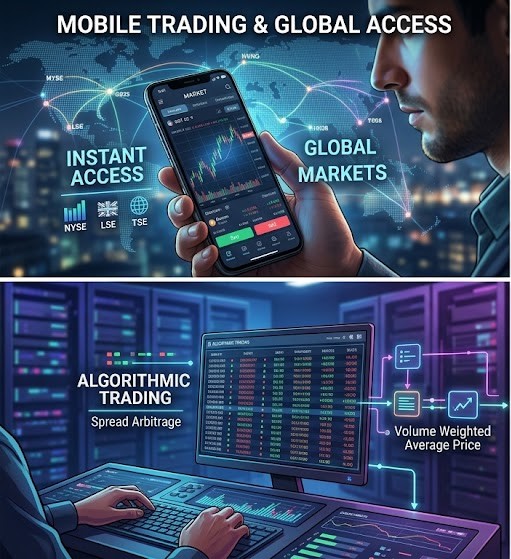
1. Mobile Trading
Smartphones have made financial markets accessible almost anywhere.
Modern trading applications allow users to monitor prices, review charts, manage portfolios, and place orders from their mobile devices.
This convenience can be useful, but it can also encourage impulsive decisions. Having constant access to the market may tempt investors to trade too frequently.
The best approach is to use technology as a tool rather than allowing market movements to control your emotions.
2. Real-Time Market Data
Investors now have access to information much faster than previous generations.
Real-time prices, financial news, economic reports, company announcements, and market analysis can all influence trading decisions.
Access to information can improve decision-making, but more information does not necessarily mean better decisions.
Successful traders need to distinguish between useful information and market noise.
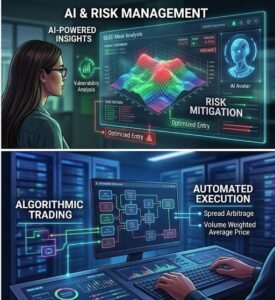
3. Artificial Intelligence in Trading
Artificial intelligence is becoming increasingly important in modern financial markets.
AI-powered systems can analyze large amounts of information, identify patterns, process market data, and assist investors with research and decision-making.
Some sophisticated trading systems can also execute predefined strategies automatically.
However, artificial intelligence is not a guaranteed path to profits. Financial markets are influenced by unexpected events, human behavior, economic conditions, and changing market sentiment.
AI can support analysis, but traders should understand how a system works before relying on its recommendations.
4. Algorithmic Trading
Algorithmic trading uses computer programs to execute trades according to predefined rules.
For example, an algorithm may be designed to buy or sell an asset when certain price, volume, or technical conditions are met.
Institutional investors have used algorithmic trading for years, but technological development continues to make advanced tools more accessible.
For individual investors, automated strategies can reduce emotional decision-making, but they can also introduce new risks if the underlying strategy is poorly designed.
The Rise of Online Trading Platforms
Online trading platforms have dramatically changed the relationship between investors and financial markets.
Instead of relying entirely on traditional financial institutions, investors can now research markets, compare investments, monitor portfolios, and execute trades through digital platforms.
Many platforms also provide educational materials and analytical tools.
Before choosing a platform, investors should consider factors such as:
- Regulation and security
- Trading fees and other costs
- Available financial products
- Customer support
- Research and analytical tools
- Account features
- Ease of use
- Withdrawal and deposit policies
A platform should be selected based on reliability and suitability, not simply because it offers a visually attractive application.
Trading vs. Investing
One of the most important distinctions beginners should understand is the difference between trading and investing.
Trading generally focuses on taking advantage of shorter-term price movements. Traders may hold positions for minutes, hours, days, or weeks depending on their strategy.
Investing usually focuses on building wealth over a longer period by owning assets that may appreciate or generate income over time.
Neither approach is automatically better.
The right choice depends on a person’s financial goals, risk tolerance, knowledge, available time, and investment horizon.
For many people, long-term investing may be easier to manage than frequent trading because it generally requires less constant monitoring.
The Role of Financial Goals
Before entering the market, it is important to establish clear financial goals.
A person saving for retirement may have a very different strategy from someone attempting to generate short-term trading income.
For example, financial goals can include:
- Building long-term wealth
- Saving for retirement
- Purchasing a home
- Creating additional income
- Preserving capital
- Saving for education
- Building financial independence
Your trading or investment strategy should support your broader financial plan rather than exist separately from it.
Risk Management Is More Important Than Profit
One of the biggest mistakes new traders make is focusing entirely on potential profits.
Experienced market participants understand that managing losses is equally important.
Risk management can involve:
- Limiting the amount invested in a single trade
- Diversifying across appropriate assets
- Understanding position sizes
- Avoiding excessive leverage
- Establishing clear exit strategies
- Maintaining sufficient cash reserves
- Avoiding money that is needed for essential expenses
No trading strategy can eliminate risk completely.
The objective is to manage risk so that a series of unsuccessful trades does not destroy your overall financial position.
The Psychology of Modern Trading
Technology has made trading faster, but human psychology has not changed.
Fear, greed, impatience, overconfidence, and the fear of missing out can influence financial decisions.
Fear of Missing Out
When prices rise rapidly, traders may feel pressure to buy because they believe an opportunity is disappearing.
This can result in entering a position without proper research or risk assessment.
Overtrading
Because modern platforms make transactions extremely easy, some traders may place too many trades.
More trades do not necessarily produce better results.
Every trade should have a clear reason behind it.
Revenge Trading
After experiencing a loss, some traders attempt to immediately recover their money by taking larger or riskier positions.
This behavior can turn a manageable loss into a much larger one.
A disciplined trader accepts that losses are part of market participation and avoids making emotional decisions after a losing trade.
Social Media and the New Trading Culture
Social media has created a completely new trading environment.
Investors can now follow financial commentators, analysts, influencers, economists, and other traders in real time.
This can provide useful educational content, but it also creates significant risks.
Online posts may encourage people to buy an asset without understanding its fundamentals, valuation, volatility, or risks.
Investors should be particularly careful with claims such as:
- “Guaranteed profits”
- “Risk-free investment”
- “Get rich quickly”
- “This stock can only go up”
- “You cannot lose with this strategy”
Financial markets do not offer guaranteed returns simply because someone presents a confident argument online.
Always conduct independent research before making an investment decision.
Cryptocurrency and the Expansion of Digital Markets
The development of cryptocurrencies has added another dimension to modern trading.
Digital assets can be traded through online platforms, often around the clock.
Cryptocurrency markets have attracted investors because of their technological innovation and potential for significant price movements.
However, cryptocurrencies can also experience substantial volatility and involve additional risks related to regulation, security, liquidity, technology, and market structure.
Anyone considering digital assets should understand these risks and avoid committing money they cannot afford to lose.
The Importance of Diversification
Diversification remains an important principle in modern finance.
Instead of concentrating all your money in one asset, diversification involves spreading exposure across different investments where appropriate.
Depending on an individual’s circumstances, a diversified portfolio may include different combinations of:
- Stocks
- Bonds
- Mutual funds
- Exchange-traded funds
- Real estate
- Cash and cash equivalents
- Other financial assets
Diversification does not eliminate losses, but it can reduce the impact that one poorly performing investment has on the overall portfolio.
Education Is the New Trading Advantage
Technology can provide access to markets, but education provides the foundation for using that access responsibly.
Before trading, beginners should understand basic concepts such as:
- Market orders
- Limit orders
- Volatility
- Liquidity
- Risk and return
- Diversification
- Position sizing
- Fundamental analysis
- Technical analysis
- Investment fees
- Taxes and regulations
A strong financial education can help investors make more informed decisions and recognize unrealistic promises.
How Beginners Can Enter the New Age of Trading
If you are new to trading, avoid starting with large amounts of money.
A more responsible approach is to begin with education and gradually develop your understanding of financial markets.
Step 1: Define Your Objective
Determine why you want to participate in the market.
Are you interested in long-term wealth building, learning about markets, or developing a short-term trading strategy?
Your objective will influence your approach.
Step 2: Understand Your Financial Situation
Before trading, review your income, expenses, savings, debts, and emergency fund.
Creating a solid monthly budget can help you determine how much money, if any, is available for long-term investing or higher-risk activities.
Money needed for rent, food, essential bills, or emergency expenses should not be exposed to unnecessary market risk.
Step 3: Learn Before You Trade
Study the basics of financial markets and understand the assets you are considering.
Never invest in something simply because it is popular online.
Step 4: Start Small
Beginners can consider starting with a small amount while learning how markets work.
The purpose of the early stage should be developing knowledge and discipline rather than attempting to become wealthy quickly.
Step 5: Create Risk Rules
Decide in advance how much risk you are willing to accept.
Having predefined rules can reduce emotional decision-making during periods of market volatility.
Step 6: Keep a Trading Journal
Record your trades and the reasons behind your decisions.
A trading journal can help identify recurring mistakes and improve discipline over time.
Step 7: Review Your Strategy
Financial markets change.
A strategy that worked under one market environment may perform differently under another.
Regularly reviewing your approach can help you determine whether it still matches your goals and risk tolerance.
Common Mistakes in the New Age of Trading
Modern technology has created new opportunities, but it has also made certain mistakes easier to make.
Trading Without a Plan
Entering the market without a strategy can lead to emotional decisions.
Using Too Much Leverage
Leverage can increase potential gains, but it can also magnify losses.
Following Online Hype
Popular opinions are not a substitute for independent research.
Ignoring Fees
Frequent trading costs can reduce overall returns.
Investing Money You Need
Money required for essential expenses should generally not be exposed to unnecessary market risk.
Expecting Quick Wealth
Trading is not a guaranteed method of becoming rich.
Sustainable financial progress usually requires patience, discipline, risk management, and realistic expectations.
What Does the Future of Trading Look Like?
The trading industry is likely to become even more technology-driven.
Artificial intelligence, automation, advanced analytics, blockchain technology, mobile platforms, and increasingly sophisticated financial tools may continue to reshape the market.
The distinction between professional and individual investors may also continue to evolve as advanced technologies become more widely available.
However, one principle is unlikely to change:
Technology can improve access to financial markets, but it cannot eliminate financial risk.
The future trader will therefore need more than sophisticated tools. Financial literacy, critical thinking, emotional discipline, and risk management will remain essential.
Final Thoughts
The new age of trading has made financial markets more accessible than ever before.
With a smartphone and an internet connection, individuals can access information and financial markets that were once available primarily through professional institutions.
This creates exciting opportunities, but it also creates responsibility.
Technology can make trading faster and more convenient, but successful financial decision-making still depends on knowledge, patience, discipline, and effective risk management.
Whether you choose to trade actively or focus on long-term investing, the foundation should remain the same: understand your financial situation, define your goals, educate yourself, manage risk, and avoid decisions based purely on emotion or online hype.
The new age of trading is not simply about having faster technology.
It is about becoming a smarter and more disciplined participant in the financial markets.