

Vous avez dit
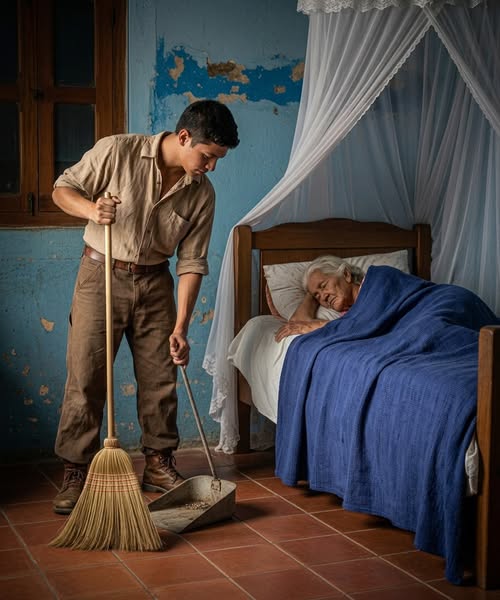
Once, as we were leaving the hospital, she took my hand and said to me in a soft voice:
That sentence stayed with me.
I smiled, trying to lighten its weight.
“Don’t worry, Doña Carmen. Just focus on getting better first.”
She squeezed my hand with her cold, bony fingers.
“Promise me.”
I don’t know why, but I promised. From then on, I kept going to her house every week, sometimes twice, even though she never gave me the 200 pesos she had promised.
At first, I thought she simply forgot.
Later, I imagined she might be waiting to gather several weeks together to pay me all at once.
Eventually, I understood the truth: she simply had nothing to pay me with.
One afternoon, while I was making her some chicken broth, I gathered the courage and said,
“Doña Carmen, don’t worry about the money. You can pay me whenever you can.”
She set the spoon down on the plate and looked at me with a strange sadness.
“You always talk as if there will still be a ‘later.’”
I didn’t know how to respond.
Over the months, my routine became part of her life, and she slowly became part of mine.
I would bring her fruit when I had a little extra money.
I bought her medicine if I noticed she couldn’t afford it.
Sometimes, after finishing the cleaning, I would sit with her for a while and listen to stories about her youth, about a husband who had already passed away, and about some children who, according to her, “had their own lives.”
She never spoke badly of them.
That impressed me.
She would only say,
“A mother never stops being a mother, even when her children forget how to be children.”
One day I found, in a half-closed drawer, several old letters returned by the mail.
All addressed to the same place in Monterrey.
All with the same last name.
None opened.
I said nothing.
Neither did she.
But that night, for the first time, when I was leaving, she asked,
“Could you come back tomorrow?”
I did.
And the next day as well.
Her health began to worsen quickly.
She could hardly get up by herself.
Her breathing came in small, struggling efforts.
One morning the doctor at the community clinic pulled me aside and told me bluntly,
“She’s very weak. I don’t think she has much time left.”
That afternoon, leaving the clinic, I helped her slowly into a taxi. Doña Carmen stayed quiet, looking out the window as if she were seeing a city that no longer belonged to her.
Before getting out in front of her house, she said,
“Diego… when I die, don’t let them throw away my things without checking the wardrobe.”
I felt a blow in my chest.
“Don’t say that.”
“Promise me.”
That word again.
And again, I nodded.
The last two weeks were very hard.
She could hardly eat anything.
I moistened her lips with water. I tucked in her blankets.
I read newspaper headlines out loud so she could feel that the world was still entering through her door.
One night she grabbed my wrist with a strength I didn’t know she still had.
“Forgive me.”
“For what?”
Her eyes filled with tears.
“For not paying you.”
Something inside me broke.
“You don’t owe me anything, Doña Carmen.”
She barely shook her head.
“Yes, I do. But it’s not money that you’re going to receive.”
I didn’t understand those words.
Two days later, when I arrived, the neighbor across the street was standing at the door with red eyes.
I knew the news before she spoke.
“She passed away at dawn, son.”
I entered the house feeling like my feet would not respond.
Everything was exactly the same.
The cup on the table.
The old radio.
The cane leaning beside the bed.
But she was no longer there.
The funeral home had taken her a few hours earlier, and her children—whom I had never seen—had said on the phone that they wouldn’t arrive until the next day.
The neighbor handed me a yellowed envelope.
“She told me to give this only to you.”
My name was written on it in Doña Carmen’s trembling handwriting.
I sat on the bed and opened it with shaking hands.
Inside there was a single letter and a small key.
The letter said:
Diego,
If you’re reading this, then I’m gone, and I can finally tell you the truth without you interrupting me with your habit of saying, “Don’t worry.”
Yes, I owed you money. A lot. More than a student should lose because of a stubborn old woman like me. And every time I saw you sweeping, cooking, taking me to the hospital, or coming back with groceries even when I had nothing to pay you, I felt ashamed. Not because you helped me, but because your hands reminded me of someone I failed too.
I had to pause for a moment.
Then I kept reading. Thirty-two years ago I had a son named Tomás. He was kind, stubborn, and good. He studied and worked at the same time, just like you. One day he became ill with a lung disease. The doctors said that with treatment he could survive, but I didn’t have enough money. So I made a cowardly decision: I used the savings he had set aside for university, thinking I would return them soon. I never could. My son never blamed me. He only said he understood. But he died six months later.
The handwriting grew more unsteady after that.
Since then I lived with two guilts: not being able to save him… and accepting his kindness as if it were endless. When you came to my door, at first I thought you were just another young man doing a job. But every broth you made me, every hospital visit, every time I saw you come in tired and still smile, I felt as if life was giving me one last chance to ask for forgiveness.
Tears were already falling onto the paper.
In the wardrobe, behind the bottom drawer, there is a metal box. The key is in this envelope. Inside you will find an envelope with money. It is not a fortune, but it is everything I managed to save by selling the few jewels I had left and collecting an old debt. You will also find the deed to this house. My children abandoned it years ago. They never visited me. They only called when they believed I still had something they could take from me. I leave them nothing.
The house is yours.
My heart felt like it stopped.
I read that line three times.
I’m not leaving it to you because you cleaned my house. I’m leaving it to you because you returned my dignity when I already felt like a burden. I’m leaving it to you because in my last months you were more family than blood. And I’m leaving it to you also for Tomás, because when I saw you walk through that door, with your worn backpack and your tired hands, it felt as if he came home for a little while.
I could barely see through my tears. I wiped my eyes





Leave a Reply